Structural Drying in Clifton Heights, PA
After the water is out, moisture still sits in framing, subfloors and drywall, so air movers and dehumidifiers run while daily meter readings show when each material is truly dry.
(888) 557-1733Ask about drying equipment- Daily meter readings
- Equipment placed by data
- Dry standard documented
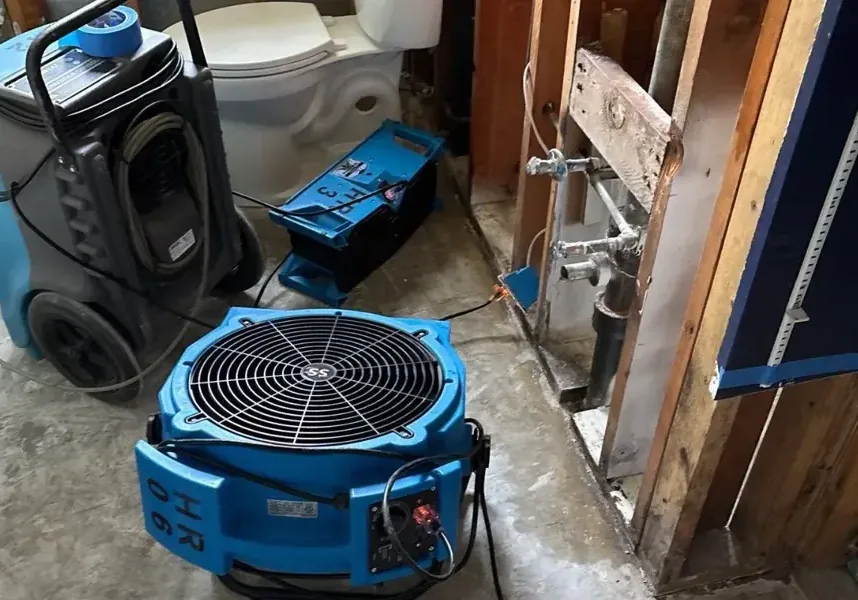
First steps for structural drying
- Map the moisture: Meters and a thermal camera mark every wet surface.
- Place the equipment: Air movers and dehumidifiers are set from the readings.
- Check every visit: Readings are recorded and equipment is moved as needed.
- Finish at normal: Equipment comes out when materials match the reference.
What does structural drying cost in Clifton Heights, PA?
Drying costs follow the number of rooms and the days of equipment. One or two rooms run $1,000 to $2,500, while a whole house or a deep loss reaches $5,500 to $8,000 or more.
One or two rooms
- Equipment placed
- Daily checks
- Short run
Level or basement
- Several rooms dried
- Wet materials removed
- Extended run
Whole house or deep drying
- Multiple levels
- Dense materials
- Extended monitoring
Ranges are typical, not a quote: the water category, the square footage, the material class and how fast drying started move the number most. Run the water damage cost calculator for a closer range.
How structural drying is handled in Clifton Heights
- 01
Call
Say what got wet and when.
- 02
Map
Meters mark wet surfaces and set the goal.
- 03
Dry
Equipment runs with readings every visit.
- 04
Verify
Equipment leaves when the numbers match.
Older construction and the Kent Mills houses
The original Kent Mills factory building and many millworker houses built around it still stand in the borough. Older construction is part of the local mix, so the crew checks what is behind wet surfaces instead of assuming, and readings decide how long each wall or floor needs equipment.
The water is out but the building still feels damp?
(888) 557-1733Ask how drying is measuredHow the equipment works together
Air movers push dry air across wet surfaces so moisture leaves the material. Dehumidifiers then pull that moisture out of the air and collect it as water, so it cannot settle onto cooler surfaces. In closed up rooms the two work as a system, which is why random fans rarely do the same job.
Readings decide when it ends
Every visit, the crew records moisture in the same spots, compares them with a dry reference and moves or removes equipment as areas finish. Drying stops when the numbers match the reference, not when the surface feels dry. The log becomes the proof an insurer or landlord can read.
After a leak or a backup
Drying follows water extraction on almost every job. For a lower level, see basement flooding cleanup, and the main structural drying page lists the standard in detail.
Structural drying across Clifton Heights and nearby communities
Drying crews work throughout Clifton Heights, including the Kent Mills area, homes near Tin Kettle Hill and properties along Baltimore Avenue and Springfield Road in ZIP code 19018.
The same service nearby: structural drying in Upper Darby, Lansdowne, Collingdale.
Related water damage services
Structural Drying questions in Clifton Heights, PA
How can anyone tell a wall is dry?
By measuring. A moisture meter reads the wall and a reference reading from an unaffected wall sets the target. Surfaces can feel dry while framing and cavities hold water.
Why does drying take several days?
Dense materials such as framing and subfloor release moisture slowly, and pushing them too fast can warp or crack them. Steady airflow and controlled humidity protect the material while it dries.
Will the equipment be loud?
Air movers and dehumidifiers hum steadily, similar to large fans, and they run around the clock during the active stage. Crews place them to reduce disruption and explain how long they will stay.
Does drying stop musty smells?
Proper drying removes the moisture that causes them. A smell that returns after equipment leaves usually means a wet area was missed, which is why final readings matter.
Is older construction harder to dry?
It can be, because older materials and added layers hold water differently. The crew reads the walls and floors with meters and adjusts the plan instead of guessing.
Let readings, not guesses, decide when drying is done
The crew maps the moisture, places equipment from the numbers, returns to measure and keeps the log until every material matches the dry reference.
(888) 557-1733Call about the dry outUpper Darby Water Damage Restoration
The township and Delaware County
Water and sewage losses only
Find us on Google