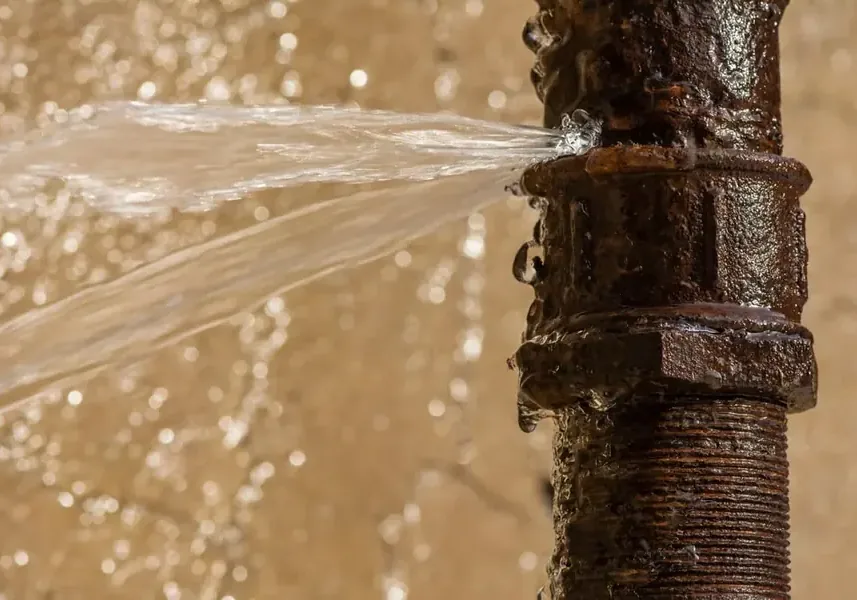
Many Upper Darby row homes still have supply pipes running inside plaster walls, and a small leak there can go unseen for weeks. This post covers the signs, the shutoff and how a wall is opened and dried.
Key takeaways
- A hidden supply pipe leak shows as stains, bubbling paint, a musty smell or a water meter that keeps moving.
- Shutting the main valve and watching the meter confirms a leak inside the walls.
- Plaster is opened with small, measured cuts at the wet spot rather than torn down.
- The wall cavity is dried with air movement and dehumidifiers, and plaster can take longer than drywall.
- A shared party wall means a neighbor may need to be told.
How a hidden pipe leak shows itself
A pipe leak inside a wall rarely produces a puddle. It leaves clues, and they are easy to miss one at a time.
- A brown or yellow stain that grows on a wall or ceiling.
- Paint that bubbles, flakes or lifts in one patch.
- A wall that feels cool or damp to the hand.
- A musty smell in a closed room.
- The sound of running water when every fixture is off.
- A water meter dial that moves with everything shut off.
Why older supply pipes fail inside walls
Row homes and twins in the township were built generations ago, and many have not been fully replumbed. Corroded galvanized pipe narrows on the inside until it pinholes, and copper can pinhole at a joint or crack where it was flexed.
Neither fails with a bang. They weep, and the plaster absorbs the water slowly, which is why a stain can appear weeks after the leak began.
Confirming the leak and shutting off the water
A simple test separates a hidden leak from an ordinary stain.
- Close every fixture and appliance that uses water.
- Read the water meter and check it again after a short wait.
- If the dial moves, close the main shutoff valve.
- Open one tap to drain the pressure from the pipes.
- Photograph the stain and mark its edge with a pencil to track whether it grows.
How a plaster wall is opened
Finding the pipe
A moisture meter and a thermal camera show where the water is. Small cuts are made at the wettest point, and the opening grows only as far as the leak requires.
Working in plaster and lath
Traditional plaster is harder and heavier than drywall, so cuts are made carefully to limit cracking and dust. Plastic barriers keep plaster dust out of the rest of the house.
A crew handling burst pipe water damage locates the leak and hands the pipe repair to a plumber, then moves straight to drying.
Where the water goes in a row home
Water from a pipe in a wall follows the framing. It runs down the stud bay, collects at the bottom plate, soaks into the floor and then travels along the joists to the next room.
In a multi-story row home, a leak on an upper floor can show up as a stain on a ceiling two rooms away from the actual pipe. A thermal camera and a moisture meter trace the path from the stain back to the source.
- The bottom of a wet wall often shows damage before the middle does.
- Floors above and below the leak are read as well as the wall itself.
- A stain on a ceiling is not always directly under the pipe.
- Baseboards and trim are lifted to read the wall behind them.
Drying a plaster wall cavity
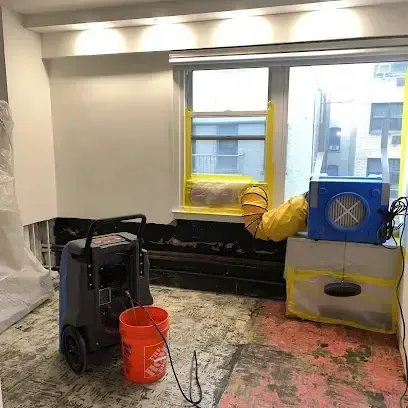
The cavity behind plaster holds moisture in the framing, the lath and any insulation. Fans, dehumidifiers and sometimes small vent holes move dry air through the cavity until meter readings fall close to a dry reference.
Structural drying on plaster takes patience, because plaster releases moisture slowly. Finishes go back only when the readings say the wall is dry.
- Wet insulation is removed, since it holds water.
- Readings are repeated at each visit and recorded.
- The ceiling below the wall is checked too, and a stain there is handled under ceiling leak water damage.
Repair or replace the pipe?
Once the wall is open, the plumber decides between a local repair and replacing a run of pipe. A second leak in the same system within a short time often means the pipe is failing along its length.
Many owners replace corroded galvanized pipe with copper or PEX while the wall is already open, since opening it again costs more than extending the work. The restoration crew dries the opening before the new pipe is closed in.
Shared party walls and neighbors
Row homes share party walls with the neighbors, so a leak in one can send water into the next. Telling the neighbor early lets both households check the wall and photograph any stains.
If water reaches the neighbor's side, each household should report its own loss to its own insurer.
Signs a pipe is nearing the end of its life
A single leak is a repair. A pattern of small problems is a warning that the whole system is wearing out, and planning a replacement beats a series of wall openings.
Homes that show several of these signs are good candidates for a full look from a plumber. More help for township homes is on the Upper Darby water damage services page.
- Rusty or brown water when a tap is first opened.
- Low pressure that has slowly worsened over time.
- Green or white crust at copper joints and fittings.
- More than one pinhole leak within a short period.
- Pipes that look pitted or flaking where they are visible.
Insurance and timing
Many policies cover sudden and accidental pipe failure but treat a long-running seep differently, so a leak should be reported as soon as it is found. Photos, meter readings and the plumber's invoice all help.
The sooner a leak is found, the less plaster, paint and framing it reaches, and the smaller the repair.
- Date every photo and keep the originals.
- Save the plumber's invoice and note what was replaced.
- Keep a record of meter readings before and after the shutoff.
- Ask the crew for written drying readings at the end.
What a finished repair looks like
After the pipe is replaced and the readings show a dry wall, the opening is closed, patched and painted. Plaster patches are blended so they do not stand out.
A dry wall with a sound pipe is the goal, and the readings are the proof.
Questions
Can a pipe leak inside a wall be found without tearing it open?
A moisture meter and a thermal camera narrow the spot, so only a small opening is needed.
Does plaster have to be replaced after a pipe leak?
Not always. If it is only damp, it can dry in place. If it is soft, crumbling or stained through, the section is replaced.
How can galvanized pipe be told from copper?
Galvanized pipe is gray and magnetic, while copper is orange-brown and not magnetic. A plumber can confirm.
Will homeowners insurance cover a hidden pipe leak?
Sudden pipe failure is commonly covered, and a slow seep over a long time may be limited. The policy wording and the insurer decide.
How long does a wall take to dry?
Several days in most cases, and longer for plaster. The meter readings, not a calendar, say when it is done.