
Flash flood water can cross a threshold fast, and the first day decides how much of the house can be saved. This post follows that day for a home in Upper Darby Township, from safety to pumping to drying.
Key takeaways
- Storm and creek water is treated as Category 3, so porous materials it touched are usually removed rather than dried in place.
- Photograph the high-water mark and every damaged item before anything is moved or thrown out.
- Stay out of standing water when outlets, cords or appliances are in it, and keep the household vacuum away from it.
- Standing water comes out first, then wet carpet, pad and low drywall, and then the structure is dried to meter readings.
- Rising water from outside is often a flood claim, and sewer backup coverage is often a separate add-on, so the policy wording matters.
Why flash flood water is treated as contaminated
Flash flooding sends runoff across yards, streets and driveways before it reaches a door. On the way it collects soil, oil, trash and whatever else is on the ground.
When storm drains and sewers fill at the same time, the water inside a house can carry sewage too. That is why the industry standard, IICRC S500, puts storm and creek water in Category 3.
The category decides what can stay and what has to go.
- Carpet, pad, insulation and drywall that soaked up Category 3 water are normally removed.
- Concrete, sealed tile and other hard surfaces are cleaned and disinfected instead of discarded.
- Children, pets and anyone with a weak immune system should stay out of the wet rooms until cleanup is done.
What the August 2018 flash flooding showed
The township has seen how quickly this happens. Flash flooding on August 13, 2018 affected an estimated 140 buildings in Upper Darby and Darby Borough.
Cobbs Creek runs along the eastern edge, facing West Philadelphia, and small creeks across Delaware County can climb fast in a hard downpour. Water also finds its own way in: a stairwell, a window well, a back door threshold or a floor drain.
The same storm can hit one block hard and skip the next, so a dry street is no proof that the house beside it is dry.
Safety comes before cleanup
Standing water inside a house can hide live electrical hazards. The first look inside should be a careful one, not a wade through the water.
- Do not step into standing water when an outlet, cord, panel or appliance is in it.
- Shut off power at the breaker only when the panel is dry and reachable without wading. Otherwise leave it and ask the utility or an electrician to make the space safe.
- Wear rubber boots and gloves and keep skin covered, since the water may carry sewage.
- Leave the house and call the utility or the fire department if gas or fuel oil can be smelled.
- Do not restart a furnace, boiler or water heater that sat in the water.
- Skip the household vacuum and any fan plugged into a wet outlet.
Photograph everything before anything moves
A claim starts with proof. Take wide shots of every room, then close shots of the high-water mark on the walls, the damaged furniture and the appliances.
Standard homeowners policies often exclude rising water from outside, flood coverage is usually a separate policy, and sewer backup is often a separate endorsement. Reading the wording early avoids surprises, and the insurer should be asked before damaged items are discarded.
A crew doing storm and creek flood cleanup also records meter readings and photos at each stage, which gives the adjuster a clear paper trail.
What gets pumped out first
Standing water
Water that sits begins soaking into plaster, pad, subfloor and masonry right away, so pumping comes before anything else. Truck-mounted units and portable pumps move the bulk, and smaller extractors finish the thin film left on the floor.
A crew doing emergency water extraction also checks where the water came in, since a window well or drain that is still taking water will refill the room.
Wet materials
Once the floor is clear, the crew sorts what stays and what goes.
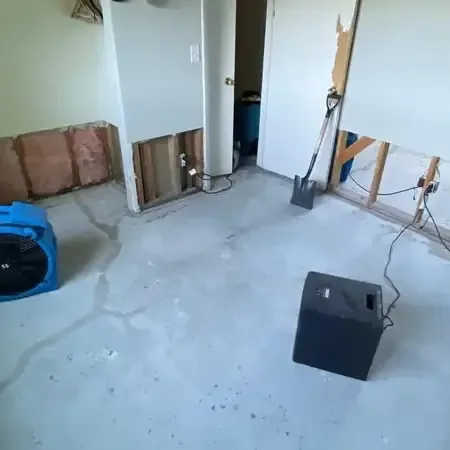
- Carpet and pad come up first because they hold both water and contamination.
- Baseboards and the lower section of drywall are cut out where the water reached them.
- Wet insulation is removed, since it stays wet and cannot be cleaned.
- Belongings are sorted into what can be cleaned, what is photographed and discarded, and what must go.
Cleaning, disinfecting and drying
Once the debris is out, hard surfaces are cleaned and treated with a disinfectant suited to Category 3 water. Drying follows.
Fans and dehumidifiers go in to pull moisture out of framing, subfloor and masonry, and moisture meters show what the surface hides. A lower level takes longer than a first-floor room because masonry holds water, so basement flooding cleanup plans around readings in the walls and slab.
Structural drying ends when the readings sit close to a dry reference, not when a date on the calendar arrives.
- Readings are taken in framing, subfloor and masonry, not only on the surface.
- A thermal camera can show wet spots behind finished walls.
- Equipment stays until the meter readings settle, which is usually a matter of several days.
Signs the damage is bigger than it looks
Surface water is only part of the loss. Moisture travels into places a flashlight does not reach, and it keeps moving after the floor looks clean.
Any of the signs below means drying is not finished, even when the room seems fine. Mold can begin to grow within a day or two in damp materials, so a quick start protects what is left.
- Baseboards or paneling that darken, swell or pull away from the wall.
- Floors that cup, feel spongy or smell musty after the surface dries.
- Paint that bubbles above the high-water mark, which means moisture has wicked upward.
- Cabinets and doors that stick or warp.
- A heavy, damp feel in the air long after the water is gone.
What a homeowner can do while waiting
Small steps protect belongings without adding risk.
- Lift small valuables, papers and electronics to a high shelf.
- Set furniture legs on foil or plastic blocks so wet floors do not stain them.
- Remove wet area rugs only if the path to them is dry and safe.
- Keep a written list of damaged items with approximate ages and values.
Questions
Is flash flood water safe to clean up without help?
A small amount on a hard floor can be handled with gloves, boots and a disinfectant. Anything that soaked carpet, drywall or insulation is Category 3 and is better left to a trained crew with the right equipment.
Does homeowners insurance cover flash flood water?
Often not by itself. Standard policies commonly exclude rising surface water, flood coverage is a separate policy, and sewer backup is a common endorsement. Check the wording and ask the insurer before throwing anything out.
How long does drying take after a flash flood?
Several days in most homes, and longer for masonry and framing. Meter readings decide when it is finished.
What should be thrown out after a flash flood?
Porous items that sat in the water, such as carpet, pad, mattresses, upholstered furniture and stuffed toys. Photograph them first so the claim has a record.
Why is water from a creek or storm called contaminated?
It crosses ground, drains and yards before it gets inside, and sewers can overflow into it. The S500 standard puts it in Category 3 for that reason.